

Gas Ball Valves / Ball Valves for Gas
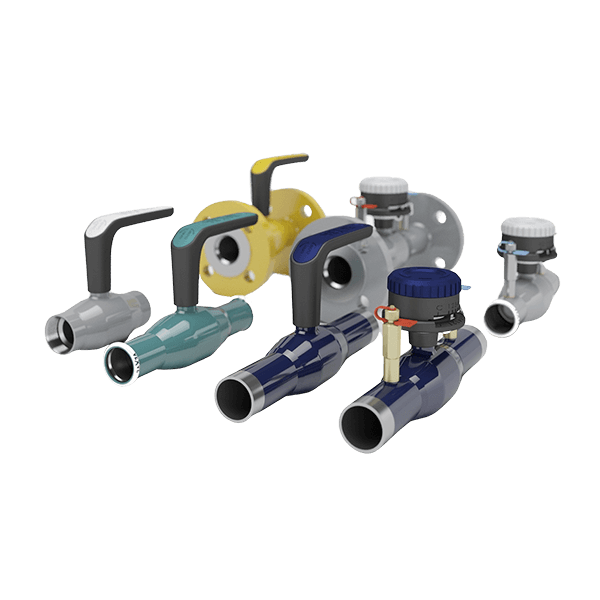
The Vexve gas ball valve (type NAVAL) has been specially designed for natural gas and compressed air systems,
to meet the special requirements of gas and compressed air.
to meet the special requirements of gas and compressed air.
The fully welded valve is manufactured from high quality materials and impresses with its high reliability and long service life.
Applications gas ball valve
- constructed for many different applications, especially suitable for natural gas and compressed air systems
- operating conditions according to data sheet
Construction gas ball valve
- fully welded steel body in a compact design
- stainless steel floating ball with spring-loaded, graphite-reinforced PTFE ball seals
- blow-out safe spindle made of stainless steel with triple sealing (two FPM/NBR O-rings + graphite-reinforced PTFE pressure ring)
- incl. hand lever or manual gear with 90° open/close stop
Versions gas ball valve
- Nominal sizes:
DN10-800 - Pressure ratings:
PN16, 25, 40 - Connection types:
welding end / welding end: DN10-800
flange / flange: DN15-800
female thread / female thread: DN15-50
welding end /flange: DN15-300
welding end / female thread: DN15-50 - Bore types:
full or reduced bore - Operation:
hand lever or manual gear, optional pneumatic, electric or hydraulic drive possible for any nominal size - Special solutions:
special customer-oriented solutions on request
Features gas ball valves
Fully welded construction of high-quality materials
- made from high-quality European materials following highest quality standards
- high user and environmental friendliness
- high energy efficiency
- robust and reliable even at high pressure and high temperatures thanks to pressure vessel steel
- compact construction
- space-saving design
- maintenance-free
- long service life


Easy installation and application, good insulating properties
- safe, quick and easy to install
- suitable for many different applications, even in demanding environments
- low torque
- no through rotation of ball possible thanks to the open/close stop
- clear position indicator
- full bi-directional tightness (EN 12266-1, leakage rate A)
- good and cost-effective insulation
This might also interest you:


Give us a call or send us an email
Phone +49 (2174) 7848 - 0 | Email: info@kaehler-armaturen.de | Arrange a consultation
Our products in the category „Gas Ball Valves“
All products in this category are available on request.
FAQ - Häufig gestellte Fragen zu Gaskugelhähnen
Was unterscheidet einen Gaskugelhahn von einem normalen Kugelhahn?
Er ist speziell für Erdgas- und Druckluftsysteme konstruiert. Gehäuse aus Druckbehälterstahl, schwimmende Edelstahlkugel mit federbelasteten, graphitverstärkten PTFE-Dichtschalen und eine ausblassichere Spindel mit dreifacher Abdichtung aus FPM- oder NBR-O-Ringen und PTFE-Druckring sind auf die Anforderungen gasförmiger Medien abgestimmt.
Welche Nennweiten und Anschlüsse sind lieferbar?
DN10 bis DN800 in PN16, PN25 und PN40. Anschlüsse gibt es als Schweißenden (DN10 bis DN800), Flansch (DN15 bis DN800), Innengewinde (DN15 bis DN50) sowie als Kombinationen Schweißende/Flansch (DN15 bis DN300) und Schweißende/Innengewinde (DN15 bis DN50). Der Durchgang ist je nach Ausführung voll oder reduziert.
Ist der Gaskugelhahn wartungsfrei?
Ja. Das vollverschweißte Gehäuse hat keine Gehäuseverschraubung, die nachgezogen werden müsste, und die Spindel hat keine Stopfbuchse. Die Armatur ist bi-direktional dicht nach EN 12266-1, Leckrate A, und für lange Standzeiten ausgelegt. Ein 90°-Anschlag verhindert das Durchdrehen der Kugel.
Welche Zulassungen hat der Gaskugelhahn?
Für Gasleitungen der öffentlichen Versorgung gelten zusätzliche Anforderungen, etwa aus dem DVGW-Regelwerk. Welche Zulassung eine konkrete Ausführung hat, prüft KÄHLER anhand des Datenblatts, bevor ein Angebot erstellt wird. Für Gas in Gebäuden gibt es außerdem Messing-Gaskugelhähne mit DIN-DVGW-Zulassung.
Kann der Gaskugelhahn mit Antrieb geliefert werden?
Ja, für jede Nennweite ist optional ein pneumatischer, elektrischer oder hydraulischer Antrieb möglich. KÄHLER stimmt den Antrieb auf Drehmoment, Stellzeit, Ansteuerung und Umgebungsbedingungen ab. Für explosionsgefährdete Bereiche gibt es Antriebe in ATEX-Ausführung.